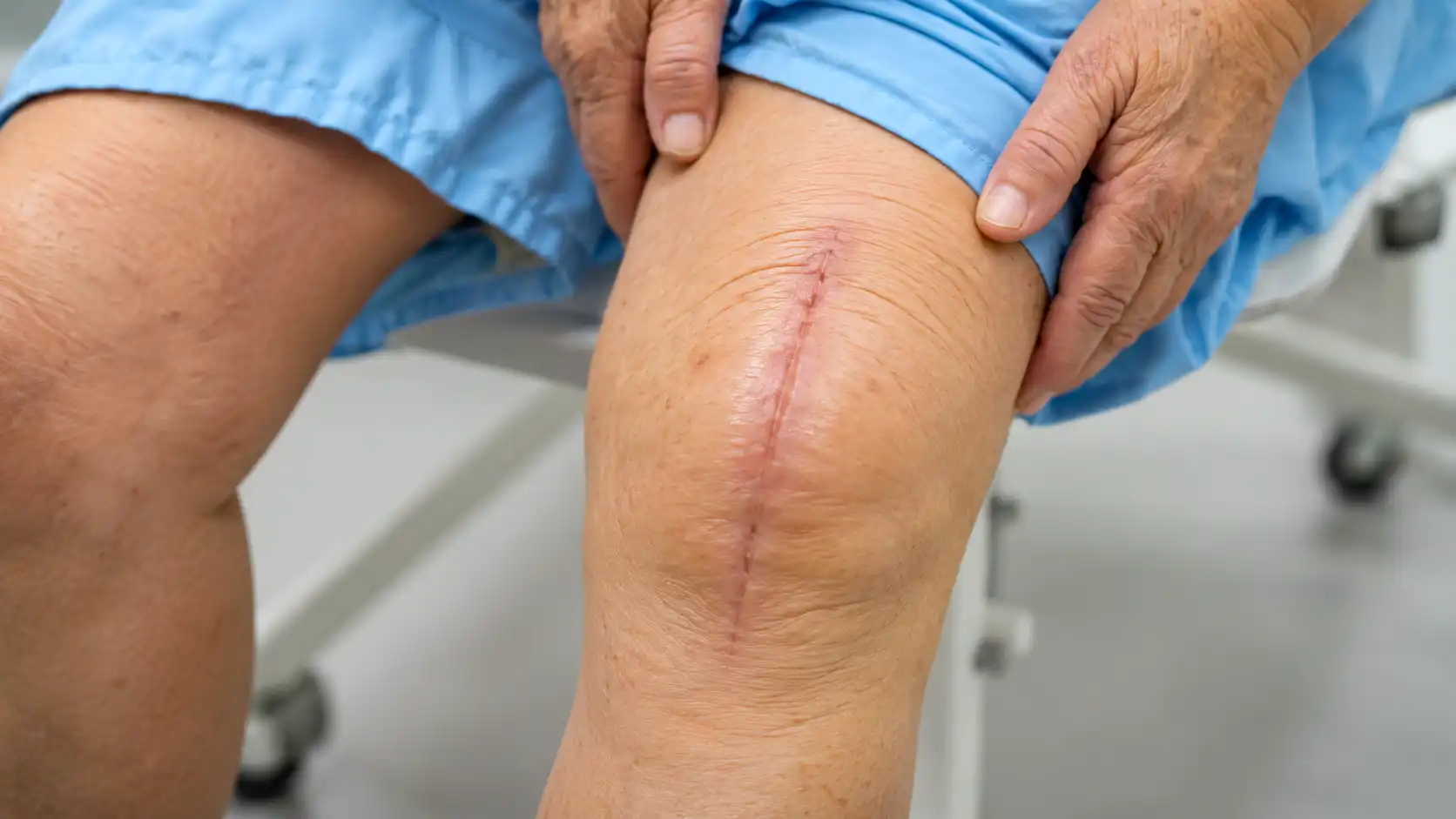
If you have been told your knee may need replacing, one of the first questions is usually whether you need a partial or a total knee replacement. The honest answer is that the choice mostly depends on how much of your knee is worn, and which parts of it. When we compare partial vs total knee replacement, we are really asking whether the damage is limited to one area of the joint or spread across it.
In this guide, we explain how surgeons make that decision, what each operation involves, how recovery and risks compare, and when it is worth speaking to a specialist. It is meant to help you ask better questions, not to replace a proper assessment of your own knee.
What Is the Difference Between Partial and Total Knee Replacement?
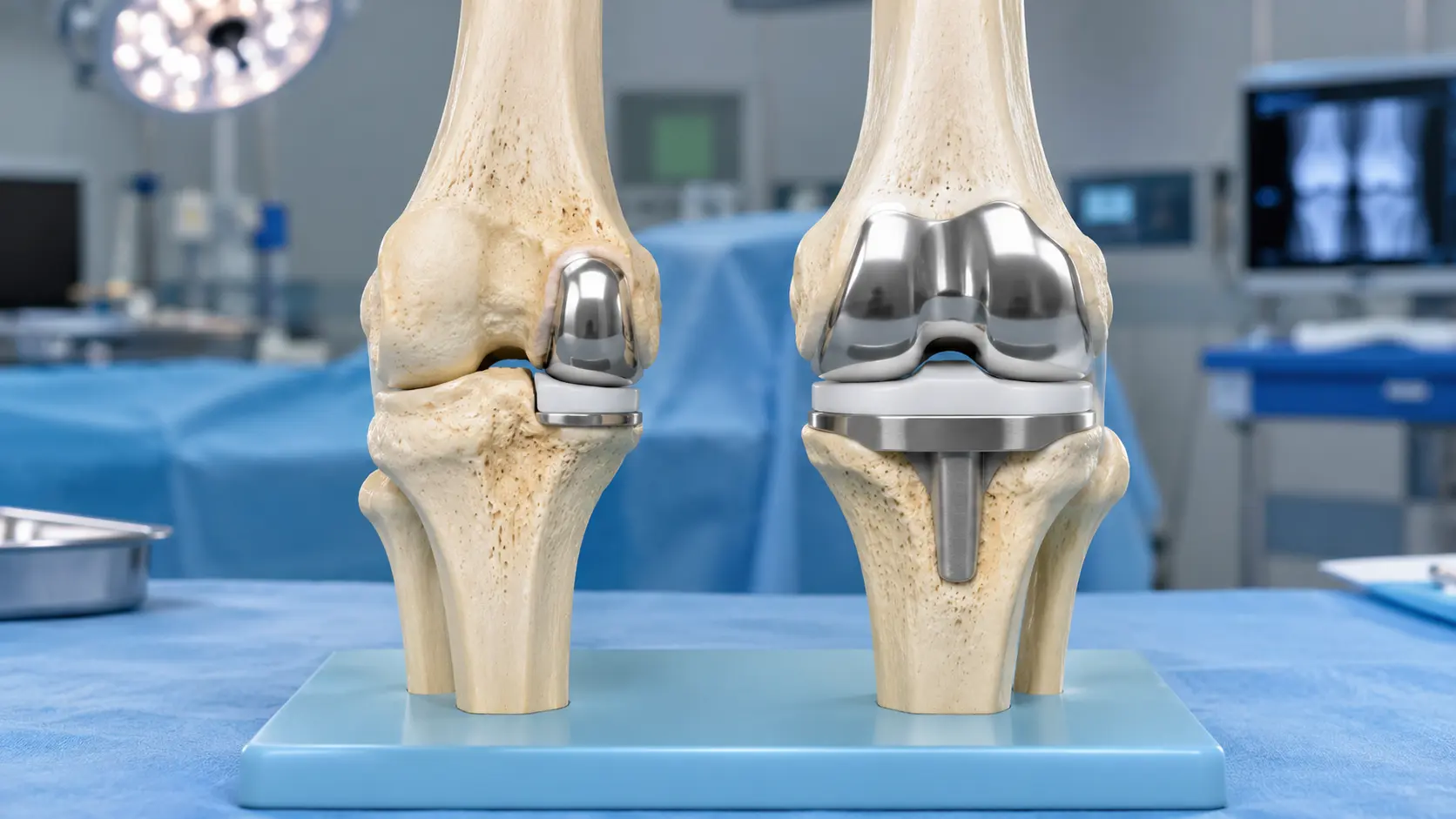
A partial knee replacement replaces only the damaged part of the knee joint, usually one of its three compartments, and keeps the healthy bone and ligaments around it. A total knee replacement resurfaces the whole joint, replacing the worn surfaces of the thigh bone and shin bone, and sometimes the underside of the kneecap.
Your knee is divided into three compartments: the inner side, the outer side, and the area behind the kneecap. Arthritis does not always affect all three at once. When it stays in one area, there may be a case for replacing only that part.
Partial Knee Replacement Procedure
A partial knee replacement, also called a unicompartmental knee replacement, replaces the worn surfaces in one compartment with metal and plastic components. Most often this is the inner side of the knee. Because the rest of the joint is left alone, we usually keep your own cruciate ligaments and the healthy cartilage and bone in the other compartments. The incision is often smaller, and many people feel the knee behaves in a more natural way afterwards.
Total Knee Replacement Procedure
A total knee replacement replaces the damaged surfaces across the whole joint. It is the more established and more widely used operation, and it is the usual choice when arthritis has spread beyond a single compartment. Because it treats the entire joint surface, it is also the more predictable option when the knee is stiff, badly misaligned or worn throughout.
How Do Surgeons Decide Between a Partial and Total Knee Replacement?
There is no single test that settles it. We look at several things together, and the final decision is made with you after we have examined your knee and reviewed your scans. These are the main factors.
Where the Arthritis Sits in Your Knee
This is the most important factor. A partial replacement is only worth considering when the wear is confined to one compartment and the rest of the joint is in good condition. If arthritis is present in more than one area, replacing just one part tends to leave the other worn areas painful, so a total replacement is usually the better choice.
Inner, Outer and Kneecap Joint Wear
Wear on the inner side is the most common pattern and the one most often suited to a partial replacement. Wear on the outer side is less common and technically more demanding. Wear behind the kneecap can sometimes be treated with a separate, smaller kneecap replacement, but it is less often the only problem. We will tell you which pattern you have and what it means for your options.
The Condition of Your Knee Ligaments
A partial replacement relies on your own ligaments, particularly the anterior cruciate ligament (ACL), to keep the knee stable. If the ACL is working well, a partial replacement may be possible. If it is badly damaged or missing, a total replacement is usually safer, because the implants then do more of the stabilising work.
Knee Stiffness and Joint Alignment
A knee that is very stiff, cannot straighten fully, or has become significantly bowed or knock-kneed over the years is less likely to do well with a partial replacement. A total replacement gives us more scope to correct alignment and restore movement. A knee that still moves well and is only mildly out of line is a better candidate for a partial operation.
Age, Activity and Physical Health
Age on its own does not decide the operation. Some younger, active people are offered a partial replacement because it preserves more of the natural knee, while some older patients are best served by a total replacement because it is a more predictable and durable operation. Your activity level, your goals and your weight all feed into the conversation, and we talk through the trade-offs openly rather than applying a fixed cut-off.
Imaging and Joint Damage Assessment
Examination tells us a great deal, but imaging confirms which compartments are affected and how healthy the rest of the joint is. We usually review weight-bearing X-rays and, where needed, an MRI scan. If you already have scans, we can go through them with you and explain what they mean in plain language, so you understand why one operation may suit your knee better than the other.
Signs You May Suit a Partial Knee Replacement
A partial knee replacement may be worth discussing if most of the following apply to you:
- Your pain comes mainly from one side of the knee, most often the inner side
- Scans show arthritis confined to a single compartment
- Your ACL is intact and the knee feels stable
- Your knee still bends and straightens reasonably well
- Any bowing or knock-knee is mild and can be corrected
- You have not had a significant inflammatory arthritis, such as rheumatoid arthritis
This is a guide rather than a checklist. Only an examination and scans can tell you whether the pattern in your own knee fits.
Signs You May Need a Total Knee Replacement
A total knee replacement is more likely to be the right choice if one or more of these describe your knee:
- Arthritis affects more than one compartment of the joint
- Pain is felt across the whole knee rather than on one side
- Your ACL is badly damaged or absent
- The knee is stiff, has lost full straightening, or is significantly misaligned
- You have inflammatory arthritis affecting the joint
- A previous injury or surgery has changed how the knee is built
Needing a total replacement does not mean your knee is in a worse state than someone offered a partial one. It means the operation is matched to the pattern of wear, which gives the most dependable result.
Partial vs Total Knee Replacement Compared at a Glance
This table gives a general comparison. Your own results will depend on your knee, your health and how closely you follow your rehabilitation plan.
| Factor | Partial Knee Replacement | Total Knee Replacement |
|---|---|---|
| What is replaced | One damaged compartment | The whole joint surface |
| Best suited to | Arthritis in one area, healthy ligaments | Arthritis in several areas, stiffness or deformity |
| Incision and tissue disturbance | Usually smaller | Usually larger |
| Early recovery | Often quicker | Usually a little slower |
| How the knee feels | Often more natural | Reliable, though some people notice it is different |
| Long-term track record | Good, but more likely to need further surgery over time | Very well established and long-lasting |
| Chance of needing revision | Higher in national registry data | Lower in national registry data |
| Flexibility if the knee changes | Can be converted to a total replacement later | Revision is possible but more involved |
Recovery After Partial and Total Knee Replacement
Recovery is one of the reasons people lean towards a partial replacement, so it is worth being realistic about what to expect. Both operations need rehabilitation, and neither is a quick fix.
Hospital Stay and Initial Recovery
After a partial replacement, many people go home within a day or two, and some on the day of surgery or the next morning. After a total replacement, a stay of one to three days is common. In both cases we encourage you to start moving early, because walking and gentle exercises help with swelling, stiffness and your confidence in the knee. Swelling and bruising can last for several weeks with either operation.
Returning to Daily Activities
People who have a partial replacement often find that they regain movement and return to everyday activities a little sooner than those who have a total replacement. As a rough guide, many people are walking comfortably without aids within a few weeks, and some return to driving and desk-based work at around four to six weeks. A total replacement often takes longer, and it can be several months before the knee feels settled. These timings vary a great deal, and your surgeon and physiotherapist will give you a plan that fits your own situation.
Risks and Limitations of Each Operation
All surgery carries risk, and both operations share the general risks of infection, blood clots, stiffness, ongoing pain and problems with the implant. We go through these with you in detail before you decide. There are also differences between the two procedures that are worth knowing about.
Revision Risk After Partial Replacement
The main limitation of a partial replacement is that arthritis can continue to develop in the parts of the knee that were not replaced. National joint registry data generally show that partial replacements are more likely than total replacements to need revision surgery over time. Revising a partial replacement to a total replacement is usually straightforward, but it does mean a second operation.
Long-Term Outcomes After Total Replacement
A total replacement is a larger operation, with a slightly longer recovery and a greater chance of residual stiffness. Most people are very pleased with the result, but some notice that the knee never feels completely natural, and kneeling can remain uncomfortable. Modern implants are durable, and many last well over a decade, but they can wear or loosen eventually, particularly in people who are very active or heavy on the joint.
Can a Partial Knee Replacement Be Changed to a Total Later?
Yes. If a partial replacement wears out, loosens, or arthritis progresses elsewhere in the knee, it can be converted to a total knee replacement. This is one of the reasons a partial replacement is a reasonable choice for the right knee, because it does not close the door on a later total operation.
It is also worth knowing that, very occasionally, a planned partial replacement is changed to a total replacement during surgery if the surgeon finds that the rest of the joint is more worn than the scans suggested. We discuss this possibility with you beforehand, so nothing comes as a surprise on the day.
When Should You Seek Medical Advice About Knee Pain and Replacement?
You do not need to be certain that you need surgery before speaking to a specialist. A knee specialist consultation is the right step when knee pain stops you doing things that matter to you, and it is worth seeking medical advice sooner rather than later if simpler treatments are no longer enough.
Warning Signs Requiring Urgent Assessment
Please seek medical advice promptly if you have a hot, swollen and very painful knee, particularly with a fever, if you cannot put any weight on the leg, or if the knee gives way or locks suddenly. If the pain follows a fall or injury, or if you notice redness spreading from the joint, do not wait for a routine appointment.
Persistent Pain and Daily Limitations
More commonly, the trigger is a gradual one. You may be waking at night with knee pain, avoiding stairs, shortening your walks, or relying on painkillers more often. If physiotherapy, weight management, injections or other non-surgical treatments are no longer giving you enough relief, that is a good time to book a knee specialist consultation. We can assess this quickly and help you understand whether a replacement is likely to be needed, or whether there is another option worth trying first.
What Happens at a Knee Specialist Consultation in London?
A good consultation should leave you with a clear diagnosis and a clear next step. At London Knee Care, we start by listening to your story: where it hurts, what you can no longer do, and what you have already tried. We then examine your knee, checking your movement, alignment and ligament stability.
We review your X-rays and, where useful, arrange further imaging. If you already have scans, please bring them with you. Once we have a full picture, we explain what is happening in your knee in plain language, set out the treatment options including those that do not involve surgery, and tell you which we think suits you best and why. If a partial or total knee replacement is appropriate, we explain the reasoning, the risks and what recovery would look like. There is no pressure to decide on the day.
Questions to Ask Your Surgeon Before You Decide
It helps to go into your appointment with a few questions ready. Whoever you see, these are worth asking:
- Which parts of my knee are worn, and which are healthy?
- Am I suitable for a partial replacement, and if not, why not?
- What are the chances I will need further surgery, and when?
- What would my recovery look like, week by week?
- What happens if the plan changes during the operation?
- Are there treatments I should try before surgery?
A surgeon who is comfortable with these questions, and who answers them clearly, is giving you the information you need to make a confident decision.

Book Your Knee Assessment With Us at London Knee Care
Choosing between a partial and a total knee replacement is not something you should have to work out alone. The right answer depends on your knee, and we can only give you a proper answer once we have examined it and looked at your scans. That is what a consultation with us is for: to turn uncertainty into a clear diagnosis and a plan you understand.
You will be seen by Mr Raghbir Khakha, a specialist knee surgeon, who will go through what is happening in your knee, which options are realistic for you, and what each would involve. You can read more about Mr Raghbir Khakha and his approach before you come. We can often see you quickly, so you do not need to spend weeks living with pain while you wait for answers. If surgery is not the right step for you, we will tell you honestly and guide you towards the treatment that is.
If you are ready to take the next step, you can book an appointment with us online, or contact us and we will help you arrange a time that suits you. Whatever you decide, we will guide you through each stage, so you always know what comes next.
Frequently Asked Questions About Partial vs Total Knee Replacement
Which Lasts Longer, a Partial or Total Knee Replacement?
Total knee replacements have the longer and stronger track record, and national registry data show they are less likely to need revision than partial replacements. Many total replacements last 15 to 20 years or more. A partial replacement can also last well, but it is more likely to need further surgery over time. How long either one lasts depends on your activity, weight and general health.
Am I Suitable for a Partial Knee Replacement?
You may be if your arthritis is limited to one part of the knee, your ligaments are healthy, and your knee still moves and sits reasonably straight. Only an examination and scans can confirm this, which is why we assess each knee individually.
Is Recovery Quicker After a Partial Knee Replacement?
Often, yes. Many people find the early recovery is a little quicker after a partial replacement, with a shorter hospital stay and an earlier return to normal activities. Rehabilitation is still essential, and recovery varies from person to person.
Does My Age Decide Which Operation I Need?
No. There is no fixed age at which one operation is chosen over the other. The pattern of arthritis, the state of your ligaments, your activity level and your own goals matter far more than your date of birth.
How Long Does a Knee Replacement Last?
Modern knee replacements are durable, and many last 15 to 20 years or more, though this is an estimate rather than a guarantee. Implants can wear or loosen over time, and people who are younger or very active may be more likely to need further surgery during their lifetime.