Sometimes, yes. A growth plate knee fracture can look exactly like a sprain, and you cannot tell the two apart by looking at the knee or by how much it hurts. Not every painful knee after a twist is a fracture. But because a child’s growth plate is still open, a missed break can matter later, so an assessment is what settles the question.
This guide covers the signs to watch for, how serious it can be at the knee, how it is diagnosed and treated, and when growth plates close.
What Is Growth Plate Injury and How Is It Different From a Sprain?
What is growth plate injury? A growth plate is a layer of soft, growing cartilage near the end of a child’s long bones. It is where the bone gets longer. A growth plate injury is damage to that layer, most often a fracture through or beside it. A sprain is different. It is a stretched or partly torn ligament, the tough band that holds a joint steady.
The two can feel the same. Both cause pain, swelling and a limp after a fall or a twist. A growth plate knee injury is a worry because the plate is still developing, and a break through it can, in some children, affect how that bone grows later. Surgeons sort these fractures into five types using the Salter-Harris system, based on how the break runs through the bone and plate.
For the wider picture of what can go wrong in a growing knee, see our page on children’s knee problems and our guide to children’s knee injuries.
Growth Plate Knee Anatomy, and Where Is the Growth Plate in Your Knee?
The growth plate knee area has two main plates. One sits at the lower end of the thigh bone (femur), just above the joint. The other sits at the top of the shin bone (tibia), just below it. In a child who is still growing, each plate appears as a thin, softer band inside the bone.
These two plates do a great deal of work. In studies of healthy children, about 70% of the growth in the thigh bone comes from the lower plate, and roughly 57% of the growth in the shin bone comes from the upper one. Between them they add much of a child’s leg length.
So where is the growth plate in your knee? You cannot feel it, but it lies close to the joint line. A child may point to pain just above or just below the knee joint, not in the joint itself. See our knee conditions page for other knee problems.
Growth Plate Knee Fracture or Sprain? How to Tell the Difference
A growth plate knee fracture and a sprain often start in the same way: a fall, a twist in sport, or a hard landing. Pain, swelling and limping follow either way. Even a specialist cannot always tell them apart without an examination and, sometimes, imaging.
A few patterns make a fracture more likely. Sharp tenderness over the bone close to the joint, not over the soft side of the knee, is one. Being unable to put weight on the leg is another. A limp that carries on for days after what seemed a minor knock is a third. None of these proves a fracture, which is why we would rather examine the knee than guess.
Growth Plate Injury Knee Symptoms Parents Notice
The growth plate injury knee symptoms below can follow a clear accident or, less often, build up from repeated strain in sport. These are the common signs of growth plate injury:
- Pain that does not settle, or keeps coming back
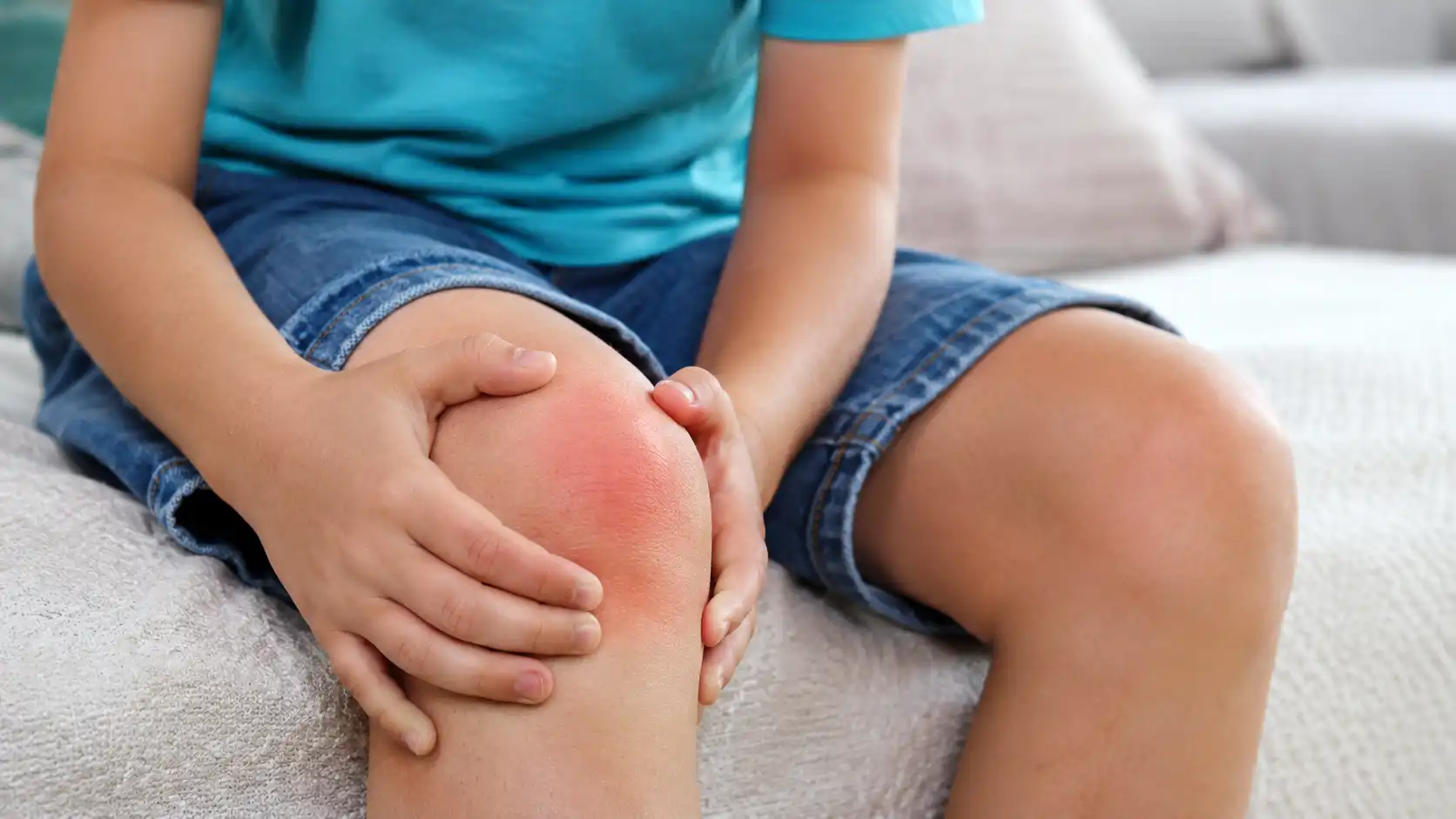
- Swelling, warmth and tenderness near the knee joint
- A limp that lasts, or refusing to put weight on the leg
- A knee or leg that looks crooked compared with the other side
- Trouble bending, straightening or moving the knee
Younger children may not describe the pain well and may simply stop playing. If the knee has not clearly improved within a few days, or you cannot tell whether it is a sprain, contact us and we will arrange an assessment.
How Serious Is a Growth Plate Fracture Around the Knee?
How serious is a growth plate fracture at the knee? Many heal well, but the knee is a higher-risk site than most, so these fractures need careful follow-up. The outcome depends on the child’s age, the bone involved, the pattern of the break and how far the bone has moved out of place.
The numbers are worth knowing, with caveats. In one pooled analysis of 564 growth plate fractures at the lower end of the thigh bone, about half (52%) showed some change in growth afterwards. About one in five (22%) ended up with a leg-length difference of more than 1.5 cm. Fractures that had moved out of place had around four times the odds of a growth problem compared with those that had not.
These figures come from older reports that included many serious injuries, so they do not describe a small crack that has not moved. They do explain why we never treat a knee growth plate injury lightly. Problems tend to appear in the first couple of years. The main one is a small bony bridge across the growth plate that slows or tilts the growth of part of the bone. Less often, a fracture makes a bone grow longer than its partner. Both are easier to manage when found early.
Can a Growth Plate Fracture Stunt Growth?
It can. The risk is higher at the knee and for fractures that have moved out of place. With a prompt assessment and the right treatment, many children do well, but no one can promise the outcome. Reviews after the bone heals, often for a year or more, are how any problem is caught. Other growth plate conditions, such as Blount’s disease, can also affect knee alignment in children, but they are separate problems with different causes.
How Is a Growth Plate Knee Fracture Diagnosed?
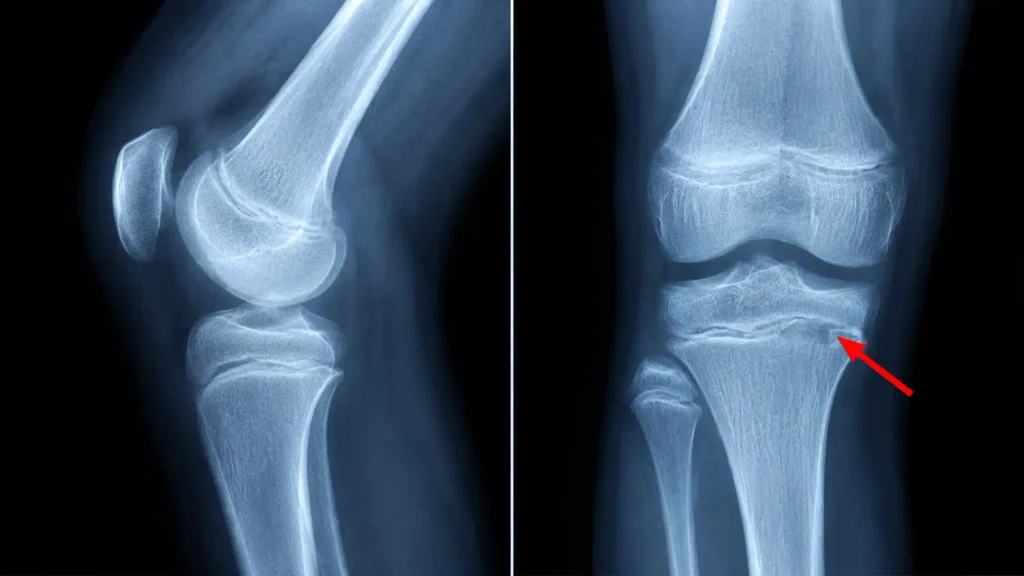
A growth plate knee fracture is diagnosed with a careful examination, then imaging. The examination matters most, because some fractures through the growth plate cannot be seen on an X-ray. The plate is cartilage, which does not show up as clearly as bone. A normal X-ray therefore does not always rule out a fracture.
At London Knee Care, assessment is led by Mr Raghbir Khakha, whose practice covers children’s knee injuries through to complex redo surgery. He asks how the injury happened, checks where the knee is tender and looks at how it moves. Where the picture is unclear, we add imaging.
What does a growth plate fracture look like on an X-ray? A clear break may show as a line or a step near the end of the bone, or as a gap that is wider than it should be. Subtle injuries can look like nothing at all, and a normal growth plate also shows as a dark line, so experience matters.
Growth Plate Injury MRI, Ultrasound and When Scans Help
A growth plate injury MRI shows cartilage, ligaments and bone bruising in far more detail than an X-ray, and a CT scan can map a complex break. Ultrasound can help in some situations, but it is less reliable for ruling a fracture out. MRI uses no radiation. Scans are not needed for every injury, as the examination and first X-ray decide what comes next. We also avoid stressing a painful knee to test it, as that can damage the growth plate further.
Growth Plate Knee Pain That Is Not a Fracture
Growth plate knee pain does not always mean a fracture. Many active children get overuse pain around the growing parts of the knee during growth spurts. The best known is Osgood-Schlatter disease: pain and a bump just below the kneecap, where the thigh muscle tendon pulls on a growing area of the shin bone. Repeated loading can also cause stress injuries in growing bone, which our guide to knee stress fractures explains.
| Growth plate fracture | Osgood-Schlatter pain | |
| How it starts | Often after a fall, twist or knock | Gradually, with sport and growth spurts |
| Where it hurts | Near the knee joint, above or below it | Just below the kneecap, over a bump |
| Swelling | Can be marked | Usually mild |
| Weight on the leg | May be difficult | Usually possible, but sore with running and jumping |
| Usual course | Needs assessment | Tends to settle over time |
Pain that follows an injury, or comes with marked swelling or trouble standing on the leg, points away from simple overuse and towards a fracture.
Pain in Growth Plate of Knee During Growth Spurts
Pain in growth plate of knee areas during a growth spurt is common, and most of the time it is not a fracture. Bone grows faster than the muscles and tendons stretch, so the pull on the growing areas increases. It is often worse after running, jumping or kneeling and eases with rest.
You may see the phrase growth plate knee syndrome online, but it is not a recognised diagnosis. It is a loose label for several different problems, which is why a proper assessment names the real cause. Growing pains are different again. They tend to affect both legs, come on at night and leave no swelling or limp.
What Age Do Knee Growth Plates Close and Why Growth Plates Close
What age do knee growth plates close? There is no single age. As a general guide, growth plates close at around 13 to 15 in girls and 15 to 17 in boys, although some knees keep growing into the late teens. The knee plates close later than those in the hands and feet, so they stay vulnerable for longer.
Why growth plates close is simple. Hormones released in puberty signal the cartilage to turn into solid bone, and the bone stops getting longer. After that, an injury is no longer a growth plate injury, and the risk of a growth problem ends. A child’s own timing can be checked on an X-ray.
Treatment for a Growth Plate Knee Fracture
Treatment for a growth plate knee fracture depends on the bone involved, the fracture type, how far the pieces have moved and the child’s age. The options include:
- A cast or splint, for fractures that have not moved out of place
- Careful realignment of the bone, sometimes under anaesthetic
- Surgery to hold the bone in position with screws, wires or plates, if the fracture has moved and is unstable
- Physiotherapy after healing, to rebuild strength and movement
- Regular reviews to check that the growth plate is growing normally
A fracture can lose position in the first week or two, so an early review matters. Our knee treatments page lists the range we offer, and our children’s knee surgery page explains how we approach operations in a growing knee.
How Long for Growth Plate Fracture to Heal in Children?
How long for growth plate fracture to heal depends on the injury, but the bone itself usually heals within several weeks, because children’s bones mend quickly. Growth plate fracture recovery time also includes getting strength, movement and confidence back, which takes longer, and the follow-up to check growth, which can run for a year or more.
If you are asking how to heal growth plate injury well, the answer is the same each time: a correct diagnosis, the right cast or surgery, and reviews that are kept.
When to Get Your Child’s Knee Assessed
Get in touch with us if a knee injury is not improving within a few days, or if your child cannot tell you clearly how it feels. We would suggest an assessment if:
- Your child cannot put weight on the leg
- Swelling is marked or getting worse
- The knee or leg looks crooked
- Pain lasts beyond a few days or returns with activity
- A limp carries on after what seemed a minor injury
Get in touch with us straight away if the foot below the injured knee looks pale or cold or feels numb, or if your child has a fever with a hot, swollen knee. These are uncommon, but they need prompt attention.
Book a Growth Plate Knee Fracture Assessment at London Knee Care
Mr Raghbir Khakha is a Consultant Orthopaedic and Specialist Knee Surgeon at London Knee Care in London. He has been in consultant practice since 2017, and his work covers knee problems from children’s knee injuries through to complex redo surgery, with a joint preservation approach. His joint preservation approach aims to protect the growing knee for the long term.
If you are worried that your child’s sprain could be a growth plate injury, we can examine the knee, arrange the right imaging and explain clearly what we find and what comes next. We will tell you plainly whether it is a sprain, a bruise or something that needs treatment. To arrange an assessment, contact us. You can also learn more about our clinic or return to the London Knee Care homepage.
- Address: 45 Queen Anne Street, London W1G 9JF
- Phone: 020 7046 8008
- Email: rk@os.clinic
Frequently Asked Questions About Growth Plate Knee Fracture
Can a Growth Plate Fracture Heal on Its Own?
The bone can start to knit by itself, but waiting is not safe. Pieces out of line can heal in the wrong position and affect the growth plate. A child with a suspected fracture should be assessed before it sets.
Does a Growth Plate Fracture Show on an X-Ray?
Sometimes. A clear break usually does. But some fractures through the growth plate cannot be seen on a plain X-ray, because the plate is cartilage. If the X-ray looks normal yet the knee is still tender and sore, further imaging or a repeat examination may be needed.
Can a Child Walk on a Growth Plate Fracture?
Some children can, especially when the fracture has not moved, so walking does not rule a fracture out. Walking on it can make an unstable fracture worse. If your child limps or avoids putting weight on the leg after an injury, please get in touch with us.
Will a Growth Plate Fracture Affect My Child’s Height?
It can, depending on the bone, the fracture type and whether the bone moved. The risk is higher at the knee and when the bone has moved. Prompt treatment and follow-up give the best chance of catching a problem early. We cannot promise an outcome, and we will explain the risk for your child’s injury.
Can My Child Play Sport After a Growth Plate Fracture?
Most children go back to sport, but only once the bone has healed and strength and movement have returned. Going back too soon risks another injury, so the timing is agreed after a review.
What Causes a Growth Plate Fracture?
Most follow a single event such as a fall, a twist or a collision in sport. Some develop from repeated strain in children who train hard. Boys are affected about twice as often as girls, most often in adolescence.