Knee arthritis is one of the most common causes of knee pain, stiffness, and reduced mobility, yet many people ignore the earliest warning signs. At London Knee Care, we regularly see patients who initially put their symptoms down to ageing, overuse, or a minor strain. A stiff knee after sleeping, a swollen knee and hot sensation after activity, or knees grinding when bending may seem harmless at first, but these can be some of the earliest indicators of joint degeneration.
The challenge with knee arthritis is that it develops gradually. Most people do not wake up one morning with severe symptoms. Instead, changes occur slowly over time, often beginning with occasional stiffness, mild swelling, or discomfort during everyday activities. By the time symptoms become persistent, cartilage damage may already be progressing.
Recognising knee arthritis signs and symptoms early allows us to assess the condition properly, identify contributing factors, and discuss treatment options that may help slow progression and maintain your quality of life.
Why Early Knee Arthritis Often Goes Unnoticed
One of the most common things we hear from patients is that they wish they had sought advice sooner. Many people continue exercising, walking, and working through discomfort because the symptoms are not severe enough to stop them completely.
Early osteoarthritis of knee joint changes rarely begin with constant pain. Instead, symptoms tend to fluctuate. Some days feel normal, while others bring stiffness, swelling, or a feeling that the knee is simply not functioning as well as it used to.
At London Knee Care, we often see active individuals who remain highly functional but notice subtle warning signs such as reduced flexibility, occasional instability, or discomfort when using stairs. These symptoms should not be dismissed, particularly if they continue for several months.
Knee Arthritis Signs and Symptoms You Should Not Ignore
The symptoms of knee arthritis vary from person to person, but certain patterns occur repeatedly.
Stiff Knee After Sleeping or Sitting
A stiff knee after sleeping is one of the earliest symptoms many patients experience. You may find it difficult to fully straighten or bend the knee when you first get out of bed. Others notice similar stiffness after sitting at a desk, driving for long periods, or watching television.
This stiffness usually improves once the knee starts moving, which is why many people assume it is nothing serious. However, recurring stiffness can be an early sign that the joint is becoming inflamed and cartilage is beginning to deteriorate.
Knees Grinding Noise and Knees Grinding When Bending
Another common complaint is a knees grinding noise during movement. Patients often describe a crunching, clicking, or grating sensation when climbing stairs, squatting, standing from a chair, or exercising.
Knees grinding when bending can occur when the cartilage surfaces within the joint become less smooth. As cartilage wears away, movement may feel rougher and less controlled.
Sore grinding knees do not automatically mean severe arthritis is present, but they should be assessed when combined with pain, swelling, stiffness, or reduced function.
Knee Arthritis With Swelling
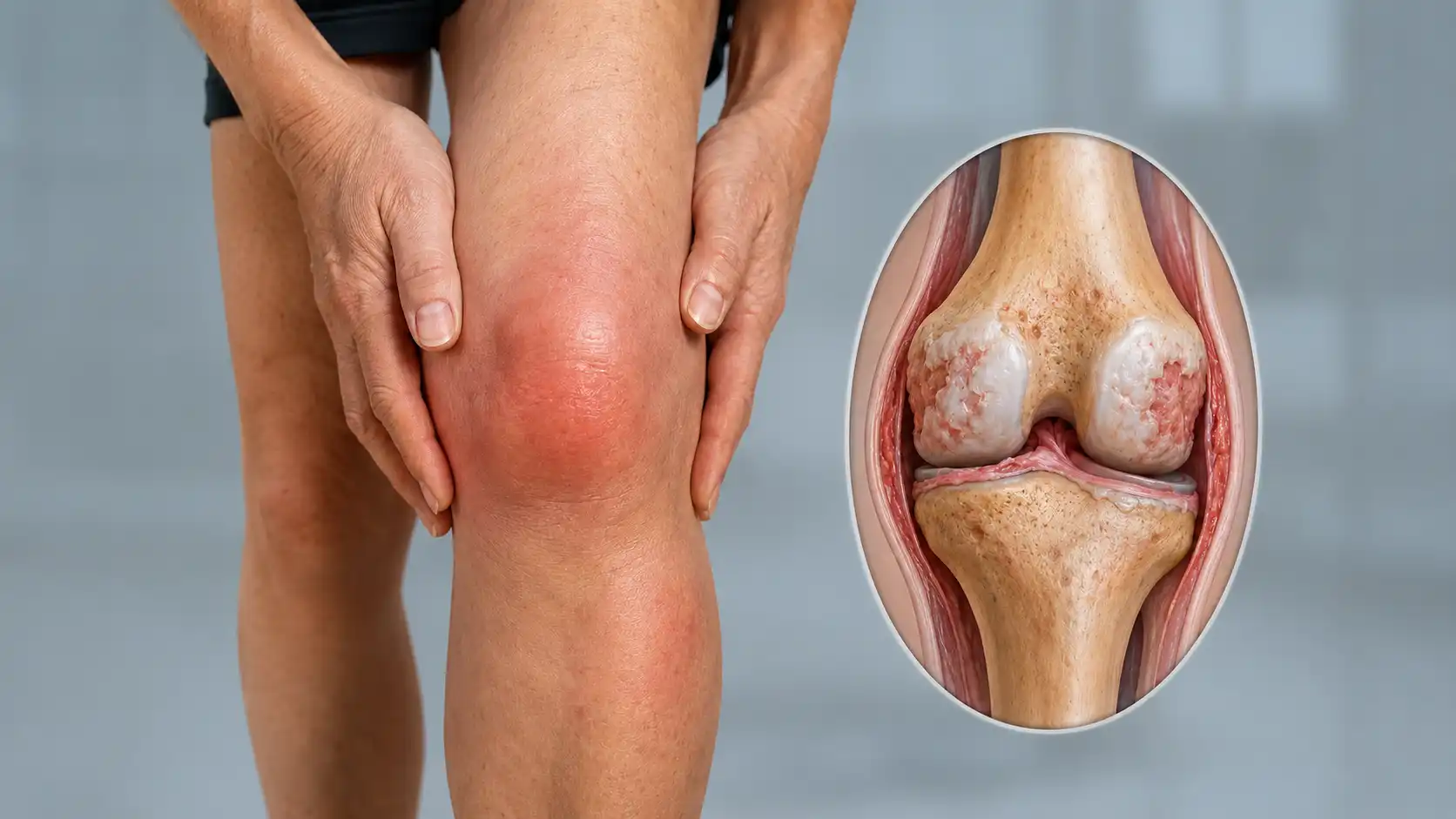
Knee arthritis with swelling is one of the most recognisable symptoms of joint inflammation. Many patients ask us, does arthritis in the knee cause swelling? The answer is yes.
As arthritis develops, irritation within the joint can trigger inflammation and increased fluid production. This often causes the knee to feel swollen, tight, and uncomfortable.
Common symptoms include:
- Swollen knee and hot sensation
- Puffiness around the kneecap
- Reduced movement
- Tightness during bending
- Flare-ups after activity
Inflammation arthritis swollen knee episodes can vary significantly. Some people experience occasional swelling after exercise, while others develop more persistent symptoms that interfere with daily life.
Can Arthritis in Knee Cause Pain in Leg?
Many people are surprised to learn that arthritis-related pain is not always confined to the knee itself.
Can arthritis in knee cause pain in leg? Yes, it can.
As the body compensates for an arthritic joint, additional stress is placed on surrounding muscles and joints. This can cause pain that extends into the shin, calf, thigh, or even the hip.
This type of referred pain is common and is one reason why professional assessment is so important. The true source of discomfort is not always obvious.
What Age Can You Get Arthritis in Your Knees?
A common misconception is that arthritis only affects older adults. We are frequently asked, what age can you get arthritis in your knees?
Although knee arthritis becomes more common after the age of 50, it can develop much earlier. At London Knee Care, we regularly assess patients in their 40s and 50s who remain active but have started noticing symptoms.
Several factors can accelerate the development of arthritis, including:
- Previous ACL injuries
- Meniscal tears
- Cartilage damage
- Family history
- Excess body weight
- High-impact sporting activity
Many patients who played football, rugby, running sports, or physically demanding occupations develop symptoms earlier than expected because of the additional stress placed on the joint over time.
Is There a Test for Arthritis in Knees?
Many patients want to know whether there is a definitive test for arthritis. The reality is that diagnosis involves a combination of clinical assessment and imaging rather than a single standalone test.
At London Knee Care, we begin by understanding your symptoms, lifestyle, previous injuries, and treatment goals. We then perform a detailed examination of the knee to assess movement, swelling, stability, tenderness, and alignment.
Imaging often forms part of the assessment process.
Knee Arthritis on MRI
Knee arthritis on MRI can provide valuable information about the health of the joint. While X-rays remain important, MRI allows us to assess cartilage, menisci, ligaments, bone marrow, and other soft tissue structures in much greater detail.
MRI may reveal:
- Early cartilage thinning
- Meniscal degeneration
- Bone marrow changes
- Joint inflammation
- Associated soft tissue injuries
One of the most important points we explain to patients is that MRI findings should never be viewed in isolation. We frequently see patients with significant changes on scans who remain highly active, while others experience considerable symptoms despite only modest imaging findings.
This is why we focus on treating the individual rather than simply treating the scan.
Could Your Symptoms Be Caused by Something Other Than Arthritis?
Not every painful knee is arthritic. Several conditions can produce symptoms that closely resemble arthritis, particularly in the early stages.
These include:
- Meniscal tears
- Knee cartilage injuries
- Tendon injuries
- Ligament injuries
- Patellofemoral pain syndrome
- Swollen knee from rheumatoid arthritis
At London Knee Care, we regularly assess patients who initially believed they had arthritis but were actually experiencing symptoms caused by a treatable meniscal tear or cartilage injury. This is one of the reasons why an accurate diagnosis is essential before deciding on treatment.
How to Prevent Knee Arthritis From Getting Worse
One of the most important questions patients ask is how to prevent knee arthritis from progressing. Although arthritis cannot usually be reversed, several evidence-based strategies may help reduce symptoms and slow further deterioration.
Maintaining a healthy body weight is one of the most effective measures. Every extra kilogram increases the forces travelling through the knee during everyday activities such as walking, climbing stairs, and exercising.
Exercise is equally important. Many people reduce activity because they worry movement will worsen their arthritis. In reality, appropriate exercise helps strengthen the muscles surrounding the knee, improves stability, and supports joint function.
Low-impact activities such as cycling, swimming, and structured strengthening exercises are often particularly beneficial. Early treatment also matters. The sooner symptoms are assessed, the more opportunities there may be to manage the condition before significant damage develops.
Our approach follows NICE osteoarthritis guidance, which recommends exercise, weight management, information, and support as core components of osteoarthritis care.
Can You Avoid Knee Arthritis Replacement?
Many patients worry that a diagnosis of arthritis means surgery is inevitable. In reality, this is often not the case.
One of our priorities at London Knee Care is helping suitable patients preserve their natural knee for as long as possible. Depending on your age, activity level, alignment, and stage of arthritis, several treatment options may be available before knee arthritis replacement surgery becomes necessary. For some patients, physiotherapy and lifestyle changes provide meaningful improvement. Others benefit from injection therapies that help reduce symptoms and improve function.
In selected cases, joint preservation procedures such as knee osteotomy may help redistribute forces within the joint and delay the need for knee replacement surgery.
The earlier arthritis is identified, the greater the opportunity to explore these options.

Modern Treatment Options for Knee Arthritis
There is no single treatment that works for everyone. The most appropriate approach depends on symptoms, examination findings, imaging results, and personal goals.
Physiotherapy remains one of the foundations of effective arthritis management. Improving strength, flexibility, balance, and movement patterns can significantly improve function.
Injection therapies may also play an important role. Depending on your individual circumstances, we may discuss:
- Corticosteroid injections
- Hyaluronic acid injections
- Platelet-rich plasma (PRP)
For suitable patients, we may also discuss Arthrosamid.
Arthrosamid is a non-biodegradable hydrogel injection developed for knee osteoarthritis. Unlike traditional injections that are gradually absorbed, Arthrosamid integrates into the synovial lining of the knee. Many patients are interested in Arthrosamid because it offers a different approach to symptom management and may provide long-lasting improvement in pain and mobility for appropriately selected individuals.
For younger and active patients, we may also discuss joint preservation procedures aimed at delaying the need for more invasive surgery.
Why Patients Choose London Knee Care
At London Knee Care, we focus exclusively on knee conditions. This specialist focus allows us to provide expert assessment and treatment for patients experiencing knee arthritis and other complex knee problems.
We understand that knee pain affects much more than the joint itself. It affects confidence, mobility, exercise, work, hobbies, and overall quality of life. This is why we take the time to understand your symptoms, review your imaging carefully, and explain every available treatment option.
Our goal is not simply to manage symptoms. Our goal is to help you remain active, maintain mobility, and preserve your natural knee whenever possible.
Book Your Knee Arthritis Assessment with Mr Raghbir Khakha
If you are experiencing knee arthritis signs and symptoms such as a stiff knee after sleeping, knee arthritis with swelling, swollen knee and hot episodes, or knees grinding when bending, now is the ideal time to seek specialist advice.
Many patients wait until symptoms become severe before arranging an assessment. Unfortunately, this often means fewer treatment options and more advanced joint damage. Early diagnosis allows us to understand what is happening inside your knee and discuss treatments that may help slow progression and improve function.
At London Knee Care, you will be assessed by a team led by Mr Raghbir Khakha, a specialist knee surgeon with extensive experience in diagnosing and treating knee arthritis, cartilage injuries, meniscal tears, and complex knee conditions.
We offer:
- Comprehensive knee assessments
- Imaging review and diagnosis
- Non-surgical treatment options
- Arthrosamid consultations
- Joint preservation procedures
- Knee replacement surgery when appropriate
Whether your symptoms are mild or already affecting your quality of life, we can help you understand your condition and identify the most appropriate path forward.
To learn more about our approach, visit London Knee Care and read more about Mr Raghbir Khakha. If you are concerned about your symptoms, we encourage you to book an appointment or contact us through our website and take the first step towards protecting your long-term knee health.
Frequently Asked Questions
What are the early signs of knee arthritis?
Common early signs include a stiff knee after sleeping, knee arthritis with swelling, knees grinding noise, discomfort during activity, and reduced flexibility.
Does arthritis in the knee cause swelling?
Yes. Arthritis can cause inflammation within the joint, leading to swelling, warmth, and stiffness.
What does knee arthritis on MRI look like?
MRI may reveal cartilage thinning, meniscal degeneration, inflammation, bone marrow changes, and other structural changes associated with arthritis.
Can arthritis in knee cause pain in leg?
Yes. Arthritis can sometimes cause referred pain into the thigh, calf, shin, or surrounding areas.
What age can you get arthritis in your knees?
Although more common after 50, knee arthritis can develop much earlier, particularly following previous injuries or cartilage damage.
Can you slow down knee arthritis?
Yes. Weight management, appropriate exercise, strengthening programmes, and early specialist treatment may help slow progression and improve symptoms.