If your knee replacement recovery has slowed down and you feel like you should be further along by now, you’re not alone, and you’re very likely not doing anything wrong. Recovery after knee replacement is rarely a straight line. Most people make rapid early gains, then hit a stretch where progress feels frustratingly slow. This is one of the most misunderstood parts of knee replacement recovery, and it deserves a proper explanation rather than vague reassurance.
This guide walks through what a realistic knee replacement recovery actually looks like, why plateaus happen, and what genuinely helps you move through them.
How Long Knee Replacement Recovery Takes
How long knee replacement recovery takes depends on your starting health, your age and the type of replacement you’ve had, but most people can expect meaningful improvement over three to six months, with full recovery generally settling in somewhere between six months and a year.
Knee replacement operation recovery isn’t a single fixed number because every knee, and every patient, heals at a different pace. What matters more than hitting an exact date is whether your progress, week to week, is generally moving in the right direction, even if some weeks feel harder than others.
Knee Replacement Recovery Week by Week
Knee replacement recovery timeline patterns tend to follow a broadly predictable shape, even though the exact pace varies from person to person.
| Stage | What to Expect |
| Weeks 0 to 2 | Swelling and discomfort are usually at their peak. Walking with a frame or crutches, early physiotherapy exercises begin. |
| Weeks 2 to 6 | Many people move from a frame to a stick, bending often improves past 90 degrees, walking distances increase. |
| Knee replacement recovery 6 weeks | Many people manage without walking aids, follow-up appointment usually takes place around this point. |
| Weeks 6 to 12 | Stamina and confidence build steadily, stairs become more manageable, some notice a plateau beginning here. |
| Knee replacement recovery 3 months | Most people feel significantly more like themselves, though stiffness and mild swelling can still appear after activity. |
| Knee replacement recovery 6 months | Strength and movement continue to improve gradually, most daily activities feel comfortable. |
| Knee replacement recovery one year | The knee has generally settled into its long-term function, with continued small gains still possible. |
Full Knee Replacement Recovery Timeline
A full knee replacement recovery timeline for a total knee replacement typically runs longer than for a partial procedure, since more of the joint surface has been replaced and the surrounding tissue needs more time to adapt. Knee replacement full recovery time is often measured in months rather than weeks, and continuing to improve gradually for up to a year is completely normal rather than a sign that something is wrong.
Total vs Partial Knee Replacement Recovery
Total Knee Replacement Recovery
Total knee replacement recovery generally takes longer because the whole joint surface is replaced. Hospital stays are typically a little longer, and building full strength and confidence often takes a full three to six months, with continued smaller improvements for up to a year. A realistic timeline for total knee replacement recovery treats these later, slower months as a normal continuation of healing rather than a stalled process.
Partial Knee Replacement Recovery
Partial knee replacement recovery, sometimes called uni knee replacement recovery, is often noticeably quicker, since only the damaged part of the joint is replaced and more of your natural knee structure stays intact. Unicompartmental knee replacement recovery time is frequently measured in weeks rather than months, with many people managing most daily activities again within three to six weeks. This doesn’t mean partial replacement is easier in every sense, simply that the tissue disruption involved tends to be smaller.
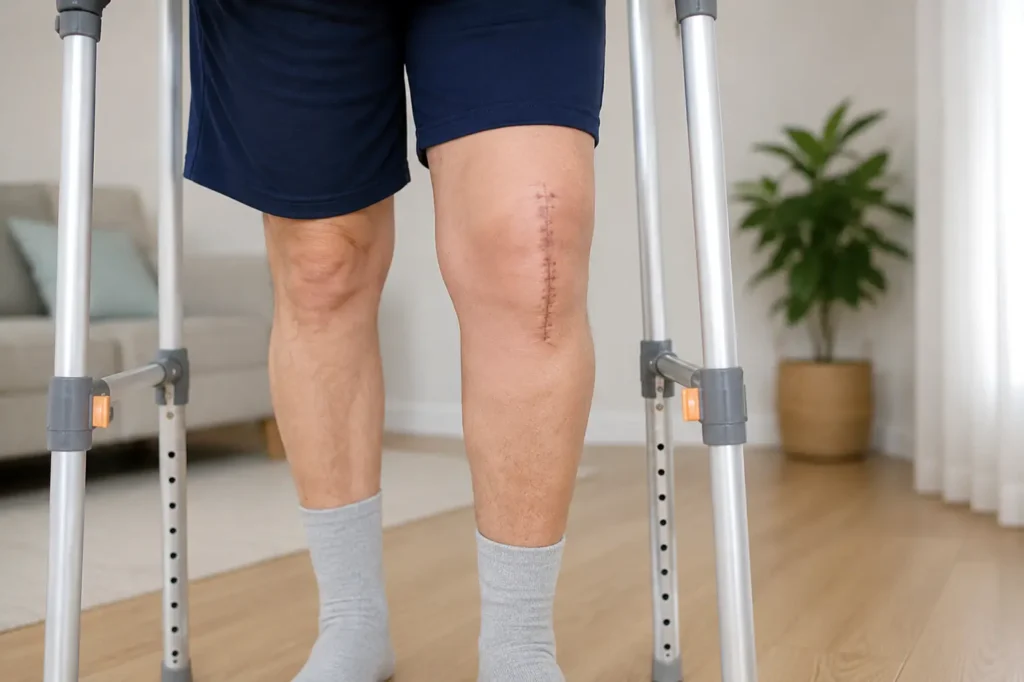
Knee Replacement Recovery Milestones
Certain milestones tend to reassure people more than a calendar date alone. Here’s a general guide to when common activities become realistic, though your own physiotherapist’s advice should always take priority over general timeframes.
- Walking after knee replacement without any aid is often achievable from around six weeks, once balance and confidence allow it.
- Driving after knee replacement usually needs at least six weeks for a total replacement, or around three weeks for a partial replacement, and only once you can perform an emergency stop safely and bend your knee enough to get in and out of the car comfortably.
- Climbing stairs after knee replacement, using a rail or stick for support, tends to become manageable from around four to six weeks.
- Sleeping after knee replacement can feel awkward in the first few weeks, though a special sleeping position isn’t usually necessary, keeping the leg supported and slightly elevated tends to help with comfort.
Knee Replacement Surgery Recovery Time Off Work
Knee replacement surgery recovery time off work depends heavily on what your job involves. If your role is largely desk based, six to eight weeks is often realistic. If your work is physically demanding, involving standing, lifting or walking for long periods, ten to twelve weeks or longer may be more appropriate. Return to work after knee replacement should always be discussed with your surgical team, since rushing back too soon can slow down your wider recovery.
Why Knee Replacement Recovery Plateaus Are Completely Normal
A knee replacement recovery plateau is one of the most common experiences during this process, and it rarely means anything has gone wrong. Many people notice progress slowing considerably somewhere around weeks eight to twelve, after the early, rapid gains have already been made.
Why is knee replacement recovery slow at this particular stage? A few genuine reasons explain it.
- Scar tissue after knee replacement naturally forms as part of healing, but excess scar tissue can restrict how freely the joint moves, contributing to knee replacement recovery stiffness. Among the most common knee stiffness after replacement causes are simply not bending and straightening the knee enough in the early weeks, since movement genuinely helps prevent tissue from tightening around the joint.
- Your rehabilitation exercises may need to change rather than simply continue, since the improvements that worked well early on often stop producing results once your knee has adapted to them.
- Knee replacement recovery pain that isn’t well controlled can limit how much you’re able to do in physiotherapy, which in turn slows further progress.
- Feeling stuck in knee replacement recovery sometimes reflects understandable fatigue or reduced motivation rather than a physical problem, and this is worth mentioning to your physiotherapist too.
A knee replacement recovery not improving despite consistent effort, week after week, is a good sign that your rehabilitation plan needs reviewing and adjusting, rather than simply doing more of the same exercises for longer. Knee replacement recovery setbacks are also different from a plateau. A genuine setback, such as a fall, an infection or a specific new injury, needs prompt medical attention rather than patience alone.
Knee Replacement Full Recovery Time and What Affects It
Several factors genuinely influence knee replacement full recovery time beyond the surgery itself. Your general fitness and health before surgery, how consistently you follow your physiotherapy programme, and whether you had any additional complexity built into your operation all play a part.
Knee Replacement Valgus Deformity Recovery
Knee replacement valgus deformity recovery is a good example of added surgical complexity. When a knee has a valgus, or knock-kneed, alignment before surgery, correcting this during the operation involves more careful soft tissue balancing around the outer side of the joint to restore a stable, straighter leg alignment. Because more work is involved in achieving and protecting this correction, early rehabilitation for valgus knees sometimes needs a little more attentive, gradual loading in the first few weeks, though the long-term recovery pattern still follows the same broad timeline as any other knee replacement.
Managing Swelling During Recovery
Total knee replacement recovery time swelling is one of the most common concerns people raise, and knee replacement swelling recovery patterns vary a lot between individuals. Some swelling for several weeks, even months, is a genuinely normal part of healing rather than something to worry about on its own. We’ve covered this in detail in our separate guide on swelling after surgery, including when swelling crosses into something that needs checking.
Red Flags During Knee Replacement Recovery
Knee replacement recovery red flags are different from the normal aches, stiffness and swelling that come with healing. Knowing when to worry after knee replacement, rather than assuming every uncomfortable day is part of the process, matters for your safety.
According to NHS guidance on knee replacement complications, you should get urgent advice from your GP or NHS 111 if you have throbbing or cramping pain in your leg, a high temperature or feeling hot, cold or shivery, oozing or pus from your wound, or redness, tenderness, swelling or pain in your knee that isn’t improving or is getting worse. These can be knee replacement recovery infection signs or, less commonly, a blood clot, and both need prompt assessment.
If you have leg pain and swelling together with difficulty breathing or chest pain, this needs immediate emergency care, since it can indicate a blood clot that has travelled to the lungs. This is rare, but it’s important to know rather than dismiss.
Signs your knee replacement recovery not going well as expected include your range of movement going backwards, pain increasing rather than easing after the first couple of weeks, or a plateau that’s genuinely stretched on for months rather than weeks. Any of these are worth having properly reviewed rather than waiting it out.
What Actually Helps When Recovery Plateaus
A few practical habits genuinely make a difference when progress feels stuck. Tracking your movement and comfort over two week blocks, rather than judging yourself day to day, gives a much clearer picture of whether you’re actually improving, since day to day variation is completely normal. Being specific with your physiotherapist about exactly which movement or activity feels hardest helps them adjust your programme precisely, rather than guessing. Consistent, shorter daily sessions tend to produce better results than occasional longer ones, and making sure your pain relief is actually adequate before physiotherapy sessions, rather than pushing through poorly controlled pain, allows you to do the exercises properly rather than compensating awkwardly. None of this guarantees a faster recovery, but it does give your knee the best possible conditions to keep progressing.
Knee Replacement Recovery Complications Explained
Most people recover from knee replacement surgery without any significant knee replacement recovery complications, and understanding what these possible complications actually are, rather than imagining worst case scenarios, tends to ease anxiety rather than increase it.
Blood clots, or deep vein thrombosis, can happen because of how blood flow changes after surgery, and this is one of the main reasons you’ll be encouraged to move regularly and may be given compression stockings or blood thinning medication in the early weeks. Wound infections are uncommon and usually respond well to antibiotics when caught early, though a deeper infection can occasionally need further surgery. Nerve or tissue damage during the operation itself is rare and often either repairs itself over time or is addressed during surgery if it’s noticed. A small number of people continue to experience bending difficulties, ongoing stiffness, or a feeling of instability, and physiotherapy usually helps considerably with these ongoing issues.
It’s also worth knowing that most knee replacements last twenty years or more, so while this is a significant operation, the results are generally very durable.

Knee Replacement Recovery Exercises and Rehab
Knee replacement recovery exercises, guided by a physiotherapist, are one of the biggest factors in how well your recovery goes. Physiotherapy after knee replacement typically starts within a day of surgery, focusing initially on gentle movement and circulation, before progressing to strength and balance work over the following weeks.
Knee replacement rehab exercises usually include the following.
- Straight leg raises and gentle knee bends to rebuild early strength and movement.
- Bending knee after replacement exercises, gradually increasing your range of motion as swelling settles.
- Balance and stepping exercises to prepare for stairs and uneven ground.
- Gradual walking programmes to build stamina and confidence over several weeks.
A knee replacement recovery physio programme should evolve as you progress. If you find yourself doing exactly the same exercises for weeks without any change, this is often exactly when a plateau develops, so ask your physiotherapist to review and adjust your plan regularly.
Knee Replacement Recovery UK Guidance and Expert Care
Knee replacement recovery UK guidance from the NHS recommends avoiding kneeling until your surgeon confirms it’s safe, avoiding sitting with your legs crossed for six weeks, and getting up to walk for a few minutes every hour in the early weeks to reduce the risk of blood clots.
If you’re looking for a knee replacement recovery specialist london patients trust, or private knee replacement recovery support tailored to your individual pace rather than a generic checklist, we’re here to help. As a knee replacement surgeon london patients regularly seek out, Mr Khakha has been in consultant practice since 2017, with a particular focus on joint preservation as well as knee replacement surgery for patients with more advanced joint damage.
As a knee replacement clinic london patients can rely on for honest, individualised advice, we always assess your specific situation rather than applying a one size fits all recovery plan. You can read more about our clinic and book directly through our booking page.
London Knee Care
45 Queen Anne Street, London W1G 9JF
Call us on 0207 046 8008
Email us at rk@os.clinic
Or visit our contact page
Frequently Asked Questions
How Long Does Knee Replacement Recovery Take?
Most people see significant improvement within three to six months, with full recovery generally settling in over six months to a year. How long is total knee replacement recovery compared with partial depends on how much of the joint was replaced, with partial replacement generally recovering faster.
Is It Normal for Knee Replacement Recovery to Plateau?
Yes, very much so. Plateaus commonly occur around eight to twelve weeks and usually reflect the need to adjust your rehabilitation approach rather than a sign that anything has gone wrong.
Why Has My Knee Replacement Recovery Stalled?
This is often down to scar tissue limiting movement, exercises that need progressing rather than repeating, or pain that isn’t well controlled enough to allow effective physiotherapy. A review with your physiotherapist or surgeon can usually identify which applies to you.
How Long Until I Can Walk Normally After Knee Replacement?
Many people walk without any aid from around six weeks, though building a fully confident, natural walking pattern often continues improving for several months afterwards.
When Does Knee Replacement Recovery Get Easier?
Most people notice a meaningful shift by around three months, once early swelling and stiffness have settled and strength has started to rebuild. If you’re finding your recovery harder than expected at any stage, our team is just a call away on 0207 046 8008.